- You want a major cultural and religious landmark near KL.
- Limestone and cave scale interest you.
- You can manage the stairs—or will value the substantial base experience.
- It fits naturally into your Kuala Lumpur schedule.
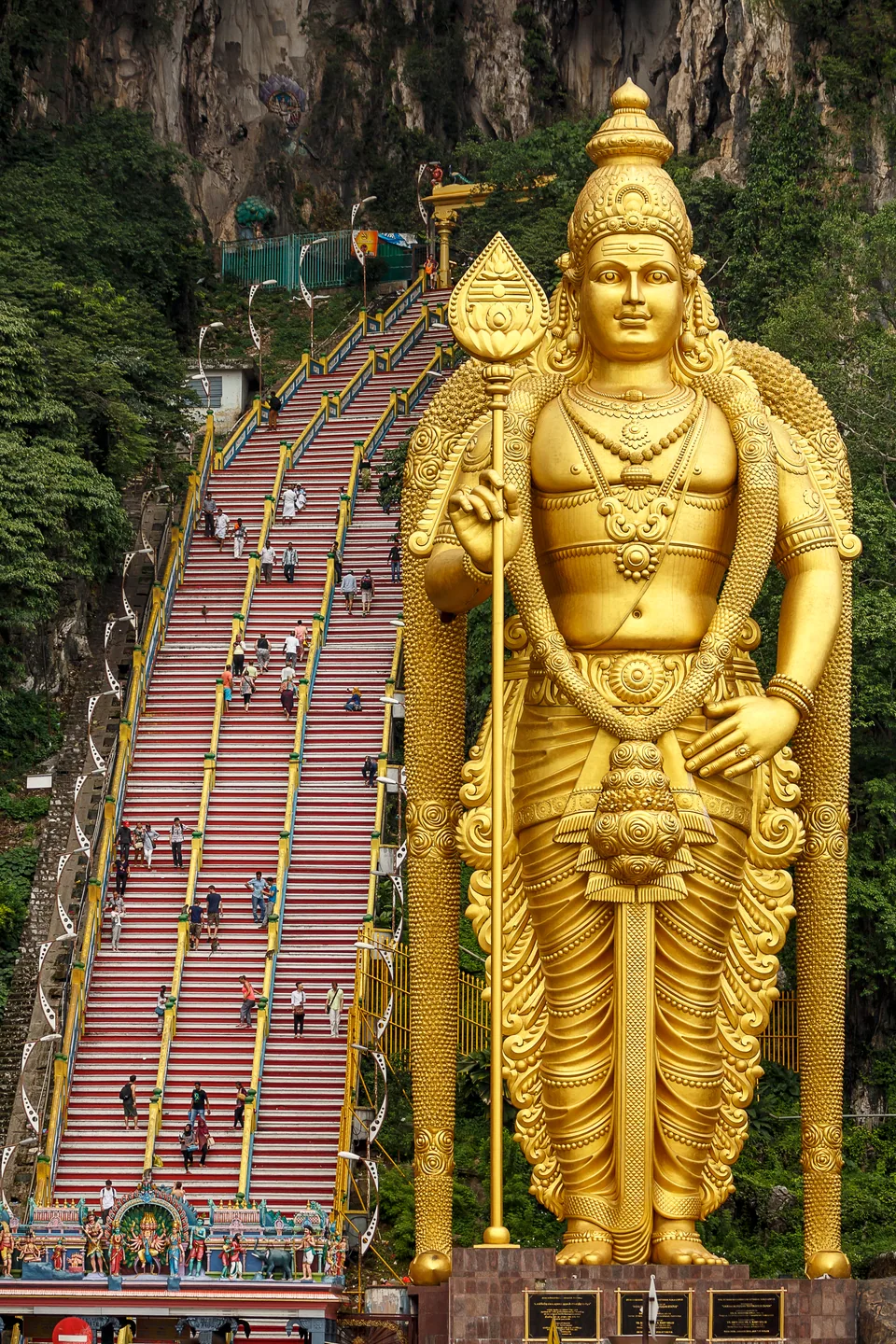
Selangor · near Kuala Lumpur
Batu Caves
A Hindu temple complex set within a dramatic limestone hill, known for its 272-step staircase, Lord Murugan statue and easy pairing with a Kuala Lumpur stay.
- Best for
- Culture · landmark · first-time KL trips
- Time
- Half-day friendly
- Effort
- 272 steps to the main cave
- Setting
- Temple · limestone · city-edge
The place in context
More than the staircase
Batu Caves is in Gombak, Selangor, outside central Kuala Lumpur. Its location matters: it is easy to include in a Kuala Lumpur stay, but it is still a distinct excursion with transport, weather and physical effort built into the visit.
The first impression is deliberately monumental—the golden Lord Murugan statue, a limestone wall and a long flight of coloured steps. Yet the point is not simply to reach the familiar photograph. The climb leads into an active Hindu religious complex within limestone that Tourism Malaysia describes as more than 400 million years old. Understanding both parts changes how you use your time and how you behave once there.
The quick decision
Does Batu Caves belong in your trip?
- Stairs are a significant mobility barrier.
- Heat or crowds materially affect your experience.
- Your Kuala Lumpur visit is extremely short.
- You mainly want a quiet nature cave.
The excursion cost would displace a higher personal priority, weather makes the exposed staircase unsuitable, or festival conditions conflict with the visit you want.
Batu Caves earns a place in many first-time Kuala Lumpur itineraries because it creates strong visual, cultural and landscape contrast without another overnight base. It is not compulsory for every traveller.
See the whole experience
What are you actually coming to see?
Think in layers rather than reducing the place to a single photograph.
Scale before the first step
The Lord Murugan statue, temple forecourt, limestone cliff and rising staircase establish the relationship between religious place and landscape. Even a traveller who cannot climb can understand much of the site’s physical identity from this level.
A changing perspective
The 272 steps are a continuous, exposed ascent. Height, heat, humidity and pauses change the view back across the forecourt. The climb is an experience in itself, but not the meaning of the complex.
Chamber, shrines and worship
The principal Temple or Cathedral Cave opens into a large limestone chamber containing Hindu shrines. Observe the spatial scale while remembering that worship, offerings and religious activity are not performances arranged for visitors.
Not every area works alike
Other temples, caves and separately operated areas may exist around the complex. Access, admission and operating status can differ, so confirm current information instead of assuming one set of conditions applies everywhere.

The staircase keeps changing
From below it reads as a single wall of steps. On the ascent it becomes a sequence of pauses, changing views and increasing exposure to the weather.
Religious context
A temple first, an attraction second
Batu Caves is an active Hindu place of worship. Depending on timing, visitors may encounter devotees, offerings, ceremonies, music or festival preparation. Their presence is not background scenery.
Dress respectfully, with shoulders and knees appropriately covered, and follow current posted temple requirements. Keep routes clear, avoid obstructing worship, maintain an appropriate noise level and pause before photographing people closely. These are practical ways to make space for the site’s actual purpose without turning etiquette into a lecture.

A different category of visit
Batu Caves during Thaipusam is a different experience
Thaipusam is a major Hindu festival, and Batu Caves becomes an important centre of devotion and pilgrimage. Crowds, processions, religious observances, transport arrangements and access conditions may differ dramatically from an ordinary day.
Approach the period as a religious event rather than a tourist spectacle. Do not sensationalise devotees or intimate acts of faith. If your dates overlap, check current-year information from temple, authority and transport sources; KTMB has operated special services for particular festivals, but previous arrangements are not promises for future years.
Practical reality
What 272 steps actually means
A meaningful physical barrier
The staircase is continuous and the principal cave experience is not something to describe as universally accessible. Pace varies substantially. Stopping is normal, and the descent also demands attention. Travellers who cannot climb can still experience the statue, cliff, forecourt, temple environment and staircase scale at the base.
The weather changes the climb
Heat and humidity can make the effort feel greater; rain can make exposed steps and outdoor surfaces more demanding. Earlier conditions may feel more comfortable, but they do not guarantee cool weather or empty stairs. Let conditions determine pace.
Footwear and water matter
Choose footwear suitable for stairs, plan water and rest sensibly, and follow any current site instructions. This is not a fitness challenge. The objective is to arrive able to observe the cave and temple respectfully.

The view back toward the forecourt shows why the descent deserves the same measured pace as the climb.
Time needed
Plan the whole visit, not only the climb
Arrival, orientation, the ascent, rest, time within the cave, descent and onward transport all belong in the time budget. A half day is a useful planning category, not a guarantee that every traveller moves at the same speed.
Transport uncertainty matters as much as walking speed. A short wait, a slower climb or time spent observing worship can turn a tightly calculated visit into a rushed one. Protect the next part of the day by giving it flexibility rather than cutting the cave experience short.
Base, staircase and principal cave, with secondary areas left out. It works only when transport and personal pace cooperate. Decide in advance that the principal experience is enough.
Enough margin to pause, observe the complex and absorb heat, rest or photography without treating each minute as lost. This is the most useful model for a first visit.
More room for religious and cultural context or separately operated areas that are confirmed open and personally relevant. Extra time should support attention, not simply add more names.
From Kuala Lumpur
Train or road?
Neither wins universally. Start with where you are staying and what the afternoon needs to do.
The network fits your starting point
Batu Caves station is on the KTM Komuter network and provides a useful public-transport connection close to the complex. KTMB currently publishes Batu Caves–Pulau Sebang service information, but 2026 patterns have changed during Klang Valley rail works. Check the current weekday or weekend timetable before leaving; do not assume fixed all-day frequency or a one-seat trip from every KL-area station.
Read the return timetable as carefully as the outward journey. The relevant comparison is not only ticket price: it is the route from your accommodation, waiting margin and where you want to go after the caves.
Direct movement matters more
Taxi, e-hailing or a private vehicle may suit a group, an awkward rail origin, limited time or a compatible onward plan. Road traffic and pickup conditions vary, so driving is not automatically faster and an estimated fare is not an evergreen planning fact.
A road journey can reduce changes without eliminating uncertainty. Allow time to find the correct pickup point, meet the vehicle and travel through variable traffic—especially when another timed activity follows.
When to go
Let conditions choose the pace
Potentially more comfortable for the exposed climb and leaves a flexible afternoon, without guaranteeing low crowds.
Possible, but heat and humidity may materially increase effort. Build in rest instead of racing the stairs.
Can work only when current access conditions and return transport leave a responsible margin. Do not arrive near closing based on an old listing.
A separate planning category requiring current-year religious, access and transport context.
Dress and conduct
Prepare for stairs and a religious setting
What to wear
Choose clothing that respectfully covers shoulders and knees, then follow the requirements displayed at the temple when you arrive. Exact enforcement or garment arrangements can change, so this guide does not promise that a particular rental or loan system will exist. Stair-suitable footwear matters more than creating a special sightseeing outfit.
What to carry
Take only what you can control on the staircase. Water and sun or rain protection may help, but loose food and unsecured belongings create avoidable problems around macaques. Carrying less also leaves your hands freer for balance.
How to photograph
Wide architectural views differ from photographing a person engaged in worship. Read posted restrictions, keep circulation routes open and ask before taking close photographs of individuals. If an observance is underway, watching without inserting yourself can be the more respectful choice.
Practical wildlife context
Monkeys are not part of the photo plan
Long-tailed macaques are commonly associated with Batu Caves. Keep food and loose belongings controlled, do not feed, touch, approach or provoke them, and follow local signs. Calm distance protects both visitors and animals; the page does not present close wildlife interaction as an attraction.
The primary decision
Is Batu Caves worth visiting?
For many first-time Kuala Lumpur visitors, yes. It supplies a visual environment unlike central KL, meaningful Hindu religious context and dramatic limestone scale while remaining compatible with a city stay. You do not need another hotel or a new destination base.
That answer is not automatic. A traveller with only a few hours in KL may gain more from staying central. The principal experience may not suit someone whose mobility is constrained by the staircase. Others may simply prioritise food, architecture, museums or neighbourhood depth. A famous landmark is useful only when it fits the actual trip.
Itinerary fit
Make Batu Caves the anchor—not an attraction marathon
Give it a morning or major block
Return to central Kuala Lumpur with the afternoon flexible. Historic KL, KLCC or one neighbourhood can follow according to energy and route.
See the KL itineraryUse the main KL sightseeing day
It fits naturally as the principal excursion before one selective central cluster. Do not add a distant afternoon simply because the calendar is short.
See the 5-day routeMore trip time, not a whole cave day
The visit can remain a purposeful partial day even when Malaysia receives a week or longer. Extra time belongs to the wider route.
See the 7-day routeWhat to combine with Batu Caves
Let one excursion lead into one flexible city choice
Batu Caves + central Kuala Lumpur
Return to the historic centre, KLCC or a neighbourhood that matters to you. Which one works depends on accommodation, transport and energy. Choose one coherent central area instead of crossing Kuala Lumpur repeatedly.
A route-compatible second stop
Another northern or route-compatible experience only earns its place when current access and the real door-to-door route have been checked. This guide avoids manufacturing a permanent tour bundle that may create more travel than value.
Keep the afternoon open
Make Batu Caves the morning anchor and decide later. This is useful when weather, rail service, crowds or personal pace make the excursion less predictable than a central-city walk.
Use limited time honestly
When Batu Caves may not deserve your limited time
Deprioritising Batu Caves can be sensible when you have only a short KL connection, the staircase prevents the principal experience you want, severe weather makes the climb unsuitable, festival conditions conflict with your preferred pace, or another experience matters more personally. This is itinerary logic—not a judgment about the importance of the religious site.
A short connection is especially poor territory for optimistic calculations. Airport or station transfers, luggage and the return to central Kuala Lumpur can consume more of the window than the visit itself. If the excursion requires rushing worshippers, ignoring conditions or gambling with onward transport, it has stopped fitting the day.
Accessibility can also change the value without making the visit meaningless. The base is visually substantial, but it is honest to recognise that someone whose priority is the principal cave may decide the stair barrier changes the answer. The guide supports that decision rather than pretending every visitor receives the same experience.
Avoid stale assumptions
Common Batu Caves planning mistakes
- 01
Treating the complex only as a staircase photo stop.
- 02
Forgetting that this is an active place of worship.
- 03
Assuming 272 exposed steps will feel trivial in heat or humidity.
- 04
Using an old KTM timetable instead of checking the current service.
- 05
Arriving without a weather or rest plan.
- 06
Carrying loose food where monkeys can reach it.
- 07
Assuming every secondary cave or attraction shares one operating status.
- 08
Planning another distant attraction immediately afterwards.
- 09
Expecting Thaipusam conditions to resemble an ordinary visit.
Before you go
Check what can change
The physical and religious character is stable. Timetables, weather and secondary-area operations are not.
- Check the current KTMB timetable if travelling by rail.
- Check current temple and secondary-area information.
- Review the weather before committing to the stairs.
- Wear respectful clothing and follow posted requirements.
- Choose footwear suitable for a long staircase.
- Plan water, heat and rest without treating the climb as a race.
- Secure loose belongings and food around monkeys.
- Decide whether Batu Caves anchors the morning or stands alone.
- Allow realistic onward travel time.