See the mountain
Mountain viewer
Let the approach and highland landscape carry the visit. A mountain view can be the priority, but cloud means it should never be the only source of value.
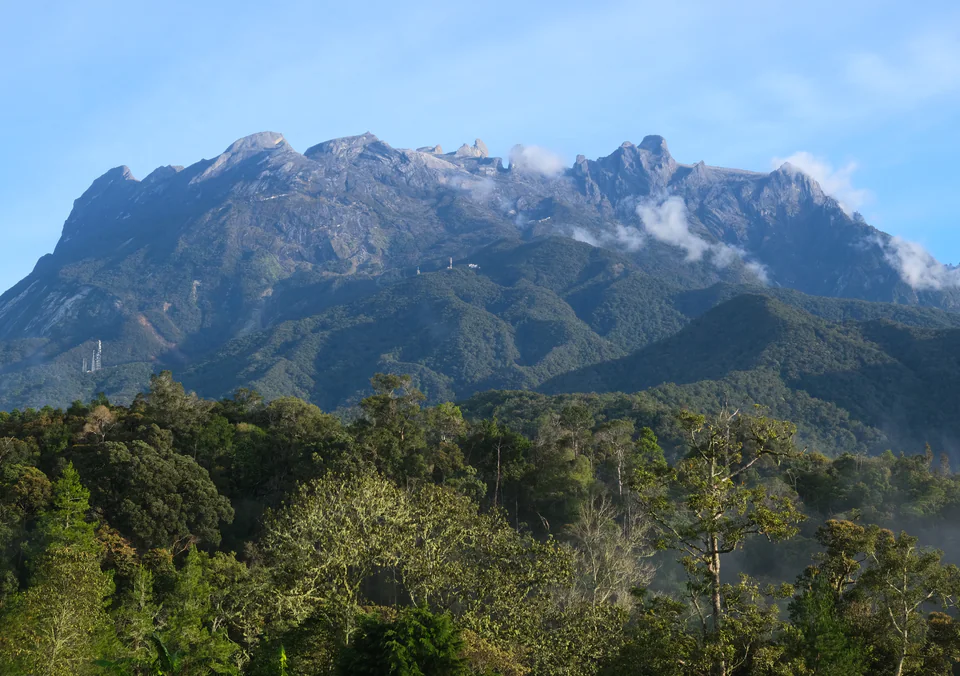
Sabah · Borneo
Stand beneath Malaysia's highest mountain without making the summit your only goal. Kinabalu Park rewards non-climbers with cool montane forest, remarkable biodiversity and a World Heritage landscape shaped by altitude.
The central promise
Kinabalu Park is a protected landscape, not shorthand for a summit itinerary. At Park HQ, about 1,520 metres above sea level, the air, forest texture and cloud already feel removed from Kota Kinabalu's coast. A non-climber can walk in montane forest, look closely at plants, visit the garden when open, understand the mountain's ecological layers and watch the granite skyline appear or disappear.
The summit is one part of a 75,370-hectare World Heritage property extending from 152 metres to Mount Kinabalu's 4,095.2-metre summit. A normal headquarters visit does not cross that full range. Its value is learning how one connected mountain system can hold such different habitats.
Come for more than a clear photograph. Cloud, moisture and changing light are not interruptions to the mountain story; they help create it.
Choose the relationship
These are equally valid ways to meet the mountain, not rungs on an achievement ladder. Choose for curiosity, conditions and trip shape.
See the mountain
Let the approach and highland landscape carry the visit. A mountain view can be the priority, but cloud means it should never be the only source of value.
Enter the park
Use headquarters, visitor facilities and whatever non-climbing areas are currently open to understand the protected landscape. This is a complete park experience, not a failed climb.
Walk the forest
Add an authorised nature trail or the Botanical Garden after confirming access, weather and terrain. Notice roots, ferns, canopy and moisture rather than collecting trail names.
Read biodiversity
Slow down for plant form, altitude and forest structure. The reward is attention: understanding why the landscape changes, not how many attractions fit.
Stay in the highlands
Use a Kundasang-area stay to reduce compression and create more than one opportunity to meet the mountain, without treating clearer weather as guaranteed.
Consider separately
Move into a different regulated trip: online booking, permit, registered guide, climbing accommodation and operational decisions. It is not the final level of a park visit.
The quick decision
Mountain landscapes, forests, botany and biodiversity interest you, or you want a cool highland contrast to Kota Kinabalu with meaning beyond a summit.
You only want a guaranteed clear mountain photograph, substantial road travel does not fit, natural terrain is unsuitable, or you expect park entry to include climbing.
You want slower forest observation, more flexibility around visibility, and Kundasang or wider highland time fits the route better than a compressed return drive.
The essential distinction
Kinabalu Park is the protected area: forest, biodiversity, visitor spaces, natural trails and a World Heritage property. Climbing Mount Kinabalu is a regulated mountain activity with its own booking and safety system.
Sabah Parks publishes a conservation fee for park entry separately from a climbing permit. Its current climbing service says 2026 reservations are online-only through Sabapak Eco, and park regulations require a registered mountain guide. Climbing accommodation is part of the booking product; guide, transport and other charges may sit outside it. Do not call all of these one “Kinabalu ticket.”
If you only want Park HQ, forest and garden experiences, you do not need a climbing permit. If you intend to climb, start with current Sabah Parks climbing information, not this evergreen overview.

Altitude explains the landscape
UNESCO describes a World Heritage property rising from 152 metres to 4,095 metres, across tropical lowland and hill rainforest, tropical montane forest, and sub-alpine forest and scrub. Sabah Parks summarises six vegetation zones. These are ecological layers across the whole property, not a checklist available from Park HQ.
Warm lowland and hill rainforest belong to the wider protected system. Most headquarters visitors do not begin at the property's lowest elevations.
Around HQ, cooler air, mosses, ferns, moisture and changing canopy make altitude physically legible without a summit attempt.
As exposure and moisture change, forest structure shifts. Cloud is part of the ecological process, not merely an obstacle to photography.
The upper mountain becomes lower, harsher vegetation and exposed granite. Seeing this zone requires regulated climbing; a park visitor understands it from context.
Altitude changes temperature and moisture; geology and unusual soils create different growing conditions; steep topography and isolation separate habitats. Together they help explain Kinabalu's exceptional richness and endemism.

World Heritage is not a photo list
Kinabalu Park entered the World Heritage List in 2000 under today's criteria (ix) and (x). Criterion ix recognises continuing ecological and biological processes; criterion x recognises globally important biodiversity and habitat. UNESCO does not manage the park and inscription is not an award for mountain scenery.
The property's 75,370 hectares hold a steep altitudinal and climatic gradient, varied geology and soils, and a sequence of habitats in a compact mountain landscape. That is why a fern, a shift in canopy height or a bank thick with moss can carry as much interpretive value as the summit silhouette.
UNESCO estimates 5,000–6,000 vascular plant species, but other sources use different categories and counts. This guide avoids stacking orchid, bird and endemic-species totals whose definitions or dates may differ. The important traveller lesson is to observe relationships, not tally names.
Three frameworks, one mountain landscape
The Sabah protected area, gazetted on 16 January 1964 and managed by Sabah Parks.
The 75,370-hectare natural property inscribed in 2000 for ecological processes and biodiversity.
A separate 4,750-square-kilometre territory designated in 2023, spanning Kota Belud, Kota Marudu and part of Ranau and connecting geological heritage with communities and a wider landscape.
Mount Kinabalu is the mountain within this geography. The Global Geopark's August 2026 revalidation mission was a periodic assessment of that separate designation; UNESCO's current list still includes Kinabalu. It did not place the World Heritage inscription under review.
A non-climber's close view
Sabah Parks uses both Botanical Garden and Mountain Garden on the same Kinabalu Park page. Treat them as the same visitor facility unless staff advise otherwise. Its value is concentration: labelled plants and a guided context can make the wider forest easier to read.
One official section currently says “Botanical Garden: last entry 3:00pm,” while the activities section says “Mountain Garden” opens 9:00am–4:00pm. Because that is an unresolved conflict within the current official page, this guide does not publish a single definitive daily window. Confirm the day's garden access with Sabah Parks.
The pictured Nepenthes rajah is a labelled display specimen recorded in the Mountain Garden. It explains the kind of botanical attention the facility supports; it is not a promise that every visitor will see the species growing wild or in a particular condition.


Non-climbing nature trails
Sabah Parks identifies a network of trails around headquarters and currently advertises a daily guided nature walk. The photographed junction names Silau Silau Trail and Bukit Tupai, but a sign and an undated brochure do not prove current opening, distance or walking time.
For that reason, this page deliberately does not reproduce historical kilometre and duration tables. Ask at the park which authorised trail is open and suitable. Choose by available time, weather, ground condition, ability, daylight and whether you want forest texture, botany or an occasional view.
Wet roots, steps and slopes alter the effort. Remain on open routes, respect closures and turn back when park advice or conditions require it. A short attentive walk is not an inferior substitute for a longer trail.
Cloud belongs here
Mount Kinabalu can be clear, briefly revealed or completely hidden. Cloud may build or lift during a visit; tropical mountain rain can arrive; a view visible from the road can disappear by the time you enter the park. Morning is often suggested for visibility, but it is a tendency, not an appointment.
Park HQ's elevation makes it cooler than Kota Kinabalu, yet “cooler” is not a forecast. Carry practical rain protection and a layer appropriate to current conditions. Wet paths change the sensible trail, while mist can sharpen the close experience of moss, fern and canopy even when it erases the skyline.
A poor panorama does not make the park worthless. Shift the visit toward forest structure, garden interpretation and World Heritage context, or accept that the mountain's atmosphere is itself evidence of the climate shaping this biodiversity.

A separate trip decision
Choose this when forest, garden, mountain landscape and a highland day are enough. No climbing permit is needed for a normal non-climbing visit; current conservation entry and facility arrangements still apply.
Choose this only when the regulated multi-stage undertaking fits your fitness, time, budget and availability. Sabah Parks says a permit and registered guide are required and 2026 bookings are online-only through its designated system. Climbing accommodation and availability form part of that planning.
Summit access and success are never guaranteed. Weather, closures and park operations can change the climb. Follow Sabah Parks and the registered guide; use authorised routes and never seek a permit workaround. This page intentionally omits a price table because conservation entry, permit, guide, transport and accommodation are separate and change independently.

Kota Kinabalu to the highlands
Sabah Parks places headquarters approximately 92 kilometres from Kota Kinabalu on the highway toward Sabah's east coast. That is useful geographic context, not a guaranteed drive time. Highland roads, traffic, weather and stops can change the day.
The durable journey is Kota Kinabalu → Crocker Range/highland road → Kundasang and park area → Kinabalu Park HQ. A private transfer, tour transport or rental car usually gives the clearest return plan. Public shared transport serves the broader route, but official visitor sources do not currently provide a stable, park-specific timetable; this guide therefore publishes no bus number, fare or last departure. Do not assume an e-hailing vehicle will be readily available for the return.
Kundasang is a settlement and highland travel base; Kinabalu Park is the protected natural area. Staying around Kundasang can reduce compression and add highland context, but its farms, accommodation and commercial attractions are not automatically inside the park.
Trip shape
Works when Kinabalu Park is the priority, road transport and return are firm, and you accept that substantial travel leaves less flexibility for cloud or trail changes.
May suit travellers wanting slower forest exploration, another mountain-view opportunity and Kundasang context. It improves flexibility, not the weather forecast.
Planning scenarios
Orient at HQ, read the landscape and use one current visitor experience without trying to “complete” the park.
Combine the garden, when open, with an appropriate short nature walk and enough margin for rain or slow observation.
Make forest, interpretation and altitude the day's purpose instead of adding a long regional attraction list.
Spread road travel and mountain-view opportunities across a slower highland plan.
Use current permit, guide, accommodation and safety operations. Never squeeze it into a casual day trip.
These are planning shapes, not guaranteed durations. Trail and garden access, weather, visibility, transport, personal pace and current park advice determine what fits.
Wider park context
Poring is a geographically separate part of the wider Kinabalu Park experience near Ranau. Including it changes the transport and time calculation; it should not be presented as a facility beside the headquarters forest.
Sabah Parks' current site-wide notice says the Poring Canopy Walkway has remained closed since 30 July 2025 until further notice for maintenance and upgrading. An older attraction page still shows opening hours. The dated closure notice takes precedence, so this guide does not recommend the walkway as operating.
Check current Sabah Parks notices before adding any Poring component. Kinabalu Park HQ already supports a meaningful non-climbing day without it.
Comfort + access
Park HQ is not a uniformly step-free urban attraction. Paths can involve slopes, steps, roots, damp surfaces and uneven ground; demand varies by route. This guide found no current official statement that every visitor facility or trail is wheelchair accessible.
Visitors with significant mobility requirements should ask Sabah Parks which exact facilities, paths, toilets and drop-off points meet their needs. Families should choose by the child's walking ability, weather, supervision needs and current trail advice rather than relying on a blanket “family-friendly” label.
Wear practical footwear, carry water and normal rain/sun protection, and bring a layer for current highland conditions. Stay on authorised routes, do not collect plants or natural objects, avoid disturbing wildlife and follow staff instructions.
Avoid the wrong assumptions
Assuming Kinabalu Park admission includes a summit climb.
Building the whole visit around one guaranteed mountain photograph.
Using old Botanical or Mountain Garden hours without reconfirming them.
Assuming every mapped nature trail is currently open.
Treating World Heritage and Global Geopark as interchangeable labels.
Using Kundasang and Kinabalu Park as names for the same place.
Treating Poring as if it were beside Park HQ.
Recommending Poring's canopy walkway while the current closure notice remains active.
Using an old climbing package, permit or accommodation workflow.
Trying to compress a regulated climb into a casual park day.
Underestimating the road journey and return arrangement.
Assuming coastal Kota Kinabalu weather predicts conditions at Park HQ.
Leave with the bigger picture
A Kinabalu visit succeeds when you understand the mountain as a living system, choose an experience that fits your trip and let forest, cloud and altitude matter as much as the skyline.
Continue planning
Balance highlands with Kota Kinabalu, islands and the rest of the state.
Plan SabahSee how Sabah can fit a longer national route without turning every day into transit.
Open the itineraryResolve seasons, transport and regional trade-offs before locking the route.
Open planningCompare the decisions behind Malaysia's cultural and natural places.
Browse places